What IS the Dark Web Anyway?
What imagery does the phrase "Dark Web" evoke in your mind?
To most, the Dark Web is an urban legend -- a monster hiding under the bed, a space normally safe and purposeful turned enigmatic and sinister. In the last twenty years the term has become a catch-all scapegoat whenever hidden, illicit activity is uncovered online. I'd like to demystify that notion. Would you be surprised to learn that crime is a far cry from the original intent behind the technologies making up most of the Dark Web?
What if this shadowy back alley is one of the last places you can walk unseen? One of the few online spaces where a semblance of privacy, anonymity, and freedom of speech persist? This is the first in a series of articles on the Dark Web, Darknets, and enhancing one's privacy online.
Legitimate Uses of the Dark Web
Culturally, the Dark Web isn't often associated with lawful activities -- and for good reason, given the amount of prominent crime that occurs there. Despite that, Darknets remain useful tools for many legitimate purposes. Tor, for instance, was built not to facilitate crime but to prevent surveillance and tracking.
The Dark Web can be used for:
- Privacy -- control over access to one's personal data, especially powerful in authoritarian contexts.
- Anonymity -- a distinct concept often conflated with privacy: the freedom to act without those actions being linked to your identity.
- Freedom of speech -- as close to a guarantee as one can get online, once confidentiality and integrity are built into the protocol itself. This enables censorship circumvention, protection of dissidents, whistle-blowing, privacy-oriented marketplaces, and OSINT research -- though it can just as easily facilitate mis- and disinformation, so question every source.
This article is not a guide or "how-to" for any particular activity; it simply aims to communicate the legitimate, ethical use of the Dark Web as a resource.
The Surface Web, and What Lies Under
When people think of accessing the Dark Web, the first thought is usually the Tor Browser. Tor has become virtually synonymous with the Dark Web, when in fact the Tor network is only one Darknet used to anonymize traffic. But what is a Darknet? First, some key terms:
- World Wide Web -- the internet as accessed through a browser.
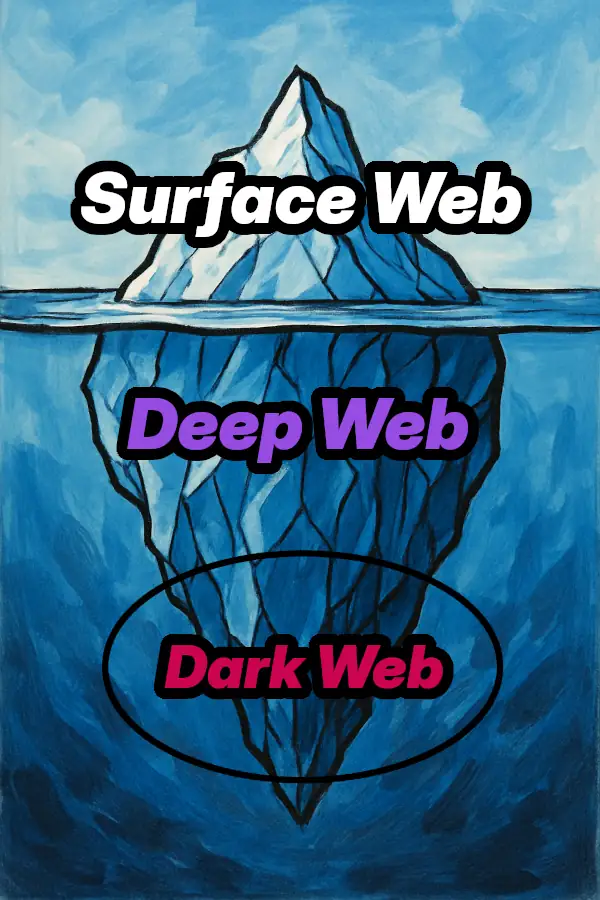
- Surface Web -- the portion of the Web that is (or can be) indexed by standard search engines; the easiest part to access.
- Deep Web -- the portion NOT indexed by search engines: backend dashboards, databases, anything private and otherwise inaccessible.
- Dark Web -- the portions of the Web hosted on individual Darknets.
Because the Dark Web isn't indexable by standard search engines, it can be considered to exist nested within the Deep Web.
Darknets: Building Blocks of the Dark Web
Clearnets
Clearnets comprise the default "layer" of the Web most people are accustomed to. Communication on a Clearnet is usually not anonymous or privacy-friendly -- most sites fingerprint users through IP address, screen size, and more. A Clearnet is the polar opposite of a Darknet; the Surface Web can itself be thought of as one very large Clearnet.
Darknets
A Darknet is an overlay network layered on top of existing communication protocols, providing anonymity, privacy, and therefore plausible deniability. It acts as a "mask" that obfuscates information tied to the user, often running on network segments that would otherwise be part of a Clearnet.
How much anonymity a Darknet actually guarantees depends on how its protocols and software were designed -- usually informed by a threat model for the project. To access a specific Darknet you need software built for it; Tor uses Onion Routing (hence "The Onion Router") and requires the Tor Browser or an equivalent purpose-built client.
For a Darknet to function well it typically needs significant user buy-in. Tor routes traffic through a randomized sequence of relays run by many different parties -- some passionate volunteers, others with less clear motivation, which is worth weighing against your own threat model. A non-exhaustive list of notable Darknets: Tor, I2P, Hyphanet, GNUnet. Many lesser-known projects exist too, with varying levels of community support, and plenty have been abandoned outright.
Bringing It All Together
From a bird's-eye view, this is the essence of the Dark Web: a grouping of individual Darknets that are largely segmented from one another, though intercommunication between them is sometimes possible -- a topic for another post.
This was the first in a series on the Dark Web, Darknets, and enhancing your privacy online. Thanks for reading -- more entries to come.